

What if the biggest barrier to your 2026 revenue isn't your software's code, but the cultural friction between your developers and the plant floor? Most tech vendors enter the sector with brilliant algorithms only to find themselves trapped in 18-month sales cycles because they can't bridge the gap between silicon and steel. Building a successful industrial automation go-to-market strategy requires more than just a slick pitch. It demands a strategy built on the reality of the control room, where reliability is the only currency that matters.
We understand that the cost of market entry, particularly in territories like EMEA where the new EU Machinery Regulation (EU) 2023/1230 dominates 2026 compliance prep, can feel prohibitive. This article provides a clear roadmap to master the technical and commercial nuances of launching industrial AI and automation solutions. We'll explore how to reduce your cost-of-sale through aligned partnerships and secure faster technical validation from plant managers who value practical utility over aesthetic fluff. You'll learn to align your value proposition with the mechanical precision required for modern, sustainable manufacturing.
Key Takeaways
- Learn how to build an industrial automation go-to-market strategy that resolves the disconnect between software development and the rugged realities of plant operations.
- Identify the four pillars of product adoption; focus on value-proposition analysis to ensure your solution meets the specific KPI requirements of site managers.
- Compare the financial impact of direct hiring against commission-aligned sales models to accelerate your entry into EMEA markets with minimal overhead.
- Anticipate the 2026 regulatory shifts, such as the EU AI Act, to ensure your automation tools remain compliant and technically viable within legacy infrastructures.
- Master a pragmatic approach to technical validation that shortens the typical 18-month sales cycle through seventeen years of control-room experience.
Beyond Generic Marketing: The Reality of Industrial Automation GTM
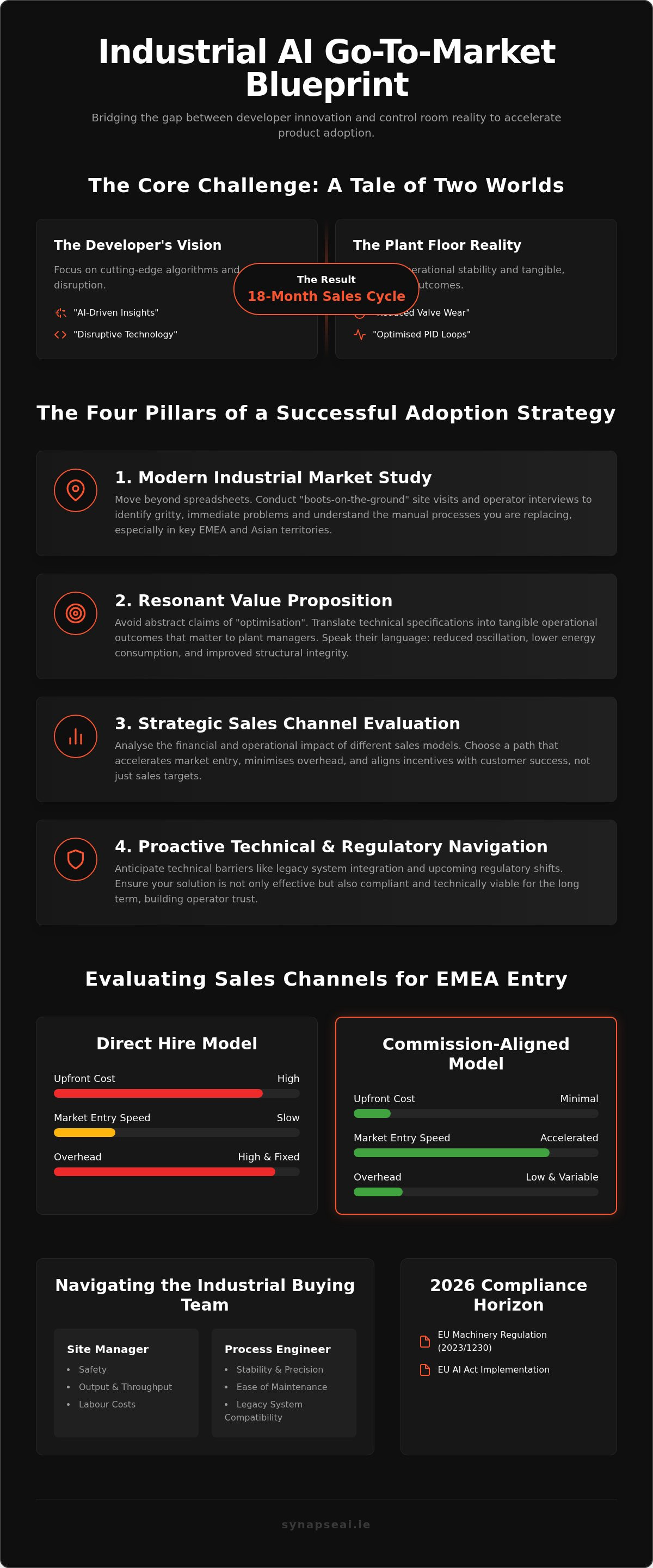
Successful entry into the factory floor isn't about catchy slogans or digital ad spend. An effective industrial automation go-to-market strategy is a blueprint for removing friction. It's the bridge between a developer's vision and the operator's reality. Many tech vendors fail because they treat the industrial sector like a standard B2B SaaS market. They prioritise "disruption" whilst the plant floor prioritises "continuity." In the control room, disruption is a dirty word that leads to unplanned downtime and lost revenue.
The history and application of automation show that success is always tied to operational stability. If your strategy doesn't account for the "Silent Killers" of adoption, your product will end up as shelfware. These killers include lack of legacy system compatibility, operator resistance to change, and the sheer weight of technical validation. To survive, you must move beyond abstract theory and focus on the tactile reality of the machines you intend to control.
The Anatomy of an Industrial Buying Team
Industrial buying teams aren't monolithic. You're speaking to two different worlds at once. The Site Manager prioritises safety, output, and labour costs. Conversely, the Process Engineer focuses on stability, precision, and ease of maintenance. Bridging these priorities requires a "boots-on-the-ground" pragmatism that respects their expertise. You're navigating a 12-to-18-month sales cycle where trust is the primary currency. This isn't a quick transaction; it's a long-term partnership built on the mechanical precision of your claims. Plant teams don't want to be your beta testers. They want to know your solution is proven and practical before they risk their production line.
Why Technical Complexity Requires Strategic Simplicity
Complexity is often a liability in the industrial sector. Vendors frequently fall into the trap of "feature-rich" messaging that ignores basic operational utility. When you speak to a control room, your narrative should focus on structural integrity and the removal of obstacles. Don't sell "AI-driven insights" when you should be selling "reduced valve wear" or "optimised PID loops." Your industrial automation go-to-market strategy must translate high-level technical muscle into gritty, actionable results. It's about moving away from technology for technology's sake. Focus instead on how your tool integrates with their existing workflows without adding unnecessary layers of friction. Simplicity in strategy demonstrates a deep understanding of the complex workflows your customers manage every day.
The Four Pillars of an Automation Product Adoption Strategy
A robust industrial automation go-to-market strategy rests on four distinct pillars that bridge the gap between innovation and implementation. Whilst many tech firms focus on top-of-funnel metrics, industrial success is won or lost at the point of integration. According to the Industrial Automation Equipment Snapshot, the global demand for advanced systems is surging, yet the barrier to entry remains the same: the operator's trust. You must validate your technology through a lens of operational survival, ensuring that your commercial model aligns with the client's actual outcomes rather than just your own sales targets.
Conducting a Modern Industrial Market Study
Market research in the industrial sector cannot be conducted from behind a desk. Spreadsheets tell you about market size, but they don't tell you about the grime on the sensors or the specific workarounds operators have built into legacy systems. You need to organise site visits and conduct operator interviews across key territories in EMEA and Asia. This "boots-on-the-ground" approach identifies untapped niches where intelligent systems can solve immediate, gritty problems. Mapping the competitive landscape requires understanding not just who else is selling software, but what manual processes you're actually replacing.
Building a Value Proposition That Resonates
Plant managers are unimpressed by abstract "optimisation" claims. They care about reduced oscillation, lower energy consumption, and structural integrity. Your messaging must convert technical specifications into operational outcomes. Using KPI templates for intelligent systems allows you to speak the language of the control room with authority. Value-proposition alignment for 2026 industrial tech means ensuring that every line of software code directly reduces a specific, measurable friction point on the physical production line. Conducting a thorough value-proposition analysis ensures your product isn't seen as a luxury, but as an essential tool for maintaining plant stability.
Beyond research and messaging, you must provide technical validation. Tools like PID tuners offer a pragmatic way to prove immediate ROI without requiring a full system overhaul. This technical "muscle" builds the credibility needed for the final pillar: commercial alignment. Whether you choose a direct sales model or commission-aligned representation, your entry strategy must reflect the long-term nature of industrial relationships. It's about building a partnership that values results over aesthetics, ensuring your solution is both proven and practical for the 2026 landscape.
Evaluating Sales Channels: Direct Hire vs. Commission-Aligned Representation
Choosing the right vehicle for your industrial automation go-to-market strategy is often the difference between a successful launch and a quiet withdrawal. Many tech vendors assume that a direct sales force is the only way to manage technical complexity. However, the hidden costs of establishing a direct presence in new territories like EMEA or Asia are substantial. Beyond the obvious salaries, you're looking at recruitment fees, local legal compliance, and the significant time-to-value lag whilst a new team builds a network from scratch. This fixed overhead creates immense pressure to close deals quickly, often at the expense of long-term site stability.
Commission-aligned representation offers a pragmatic alternative that shifts the risk from the vendor to the partner. This model ensures that the sales agent wins only when you win, creating a deep incentive to find the right technical fit for the product. By leveraging a "Bridge-Builder" who already possesses established site relationships, you bypass the friction of cold entry. These partners don't just provide leads; they provide access to the control room, backed by years of earned trust. This approach mitigates the risk of your solution becoming a "languishing product" that sits on a plant floor shelf because it never found its champion amongst the operators.
When to Choose Commission-Based Industrial Sales
This model is particularly effective when entering niche markets where local language and technical culture are primary barriers. If you're launching a "wedge" product, such as a digital logbook, to gain initial site access, a commission-based partner can scale your presence rapidly across multiple regions without the burden of a heavy fixed payroll. It allows you to test the waters in territories like EMEA whilst maintaining a lean operation. This flexibility is vital for vendors who need to prove their value-proposition analysis in real-world settings before committing to a massive capital expenditure on a direct team.
Criteria for Selecting an Automation Sales Partner
- Technical Literacy: Your partner must speak the language of the control room fluently. They shouldn't just understand the software; they must understand the mechanical precision of the processes it controls.
- Network Depth: Look for partners with 15+ years of experience in technical environments. This depth ensures they aren't just selling a tool but are solving a problem for a colleague they've known for a decade.
- Strategic Support: Avoid "lead generators." A true partner provides comprehensive value-proposition analysis and understands how to align your product features with site-specific KPIs.
Ultimately, the choice depends on your appetite for risk and your need for speed. A commission-aligned model provides the "muscle" of a veteran sales team with the agility of a startup. It ensures that every conversation is focused on utility and results, mirroring the well-optimised industrial processes you're looking to automate.
Navigating Technical Barriers and Regulatory Compliance
Technical friction is the silent killer of many a brilliant innovation. Developers often build elegant AI models that falter when they encounter the electrical noise and sensor drift of a twenty-year-old production line. This disconnect fuels the most common objection from plant managers: "It works on paper, but it won't work on my site." To overcome this, your industrial automation go-to-market strategy must prioritise data-driven decision support that proves reliability in the harshest environments. It's about moving from abstract theory to silicon-and-steel reality.
Regulatory landscapes in 2026, specifically the EU AI Act, add a new layer of complexity for tech vendors. These regulations are not just administrative hurdles; they are structural requirements that demand transparency and safety-by-design. By embracing these standards early, you turn a potential barrier into a trust-building milestone. It signals to the buyer that your solution is not just innovative, but also stable and secure for long-term deployment within their existing infrastructure. Navigating these requirements with confidence demonstrates a professional register that resonates with corporate compliance officers and plant engineers alike.
The Role of Digital Tools in Technical Validation
Gathering baseline performance data is a prerequisite for any serious technical conversation. Tools like digital logbooks and control-room activity trackers allow you to document the current state of a plant with mechanical precision. This evidence provides the muscle needed for technical validation. PID tuning tools offer a pragmatic way to secure a "quick win" by demonstrating immediate improvement in loop stability. Integrating these proprietary software tools into your wider narrative proves that you understand the operator's daily frustrations and have the means to remove them.
Compliance as a Competitive Advantage
Compliance requires more than legal paperwork; it requires lived-in operational awareness. You must demonstrate that your software meets global safety standards without introducing new friction to the operator's workflow. This builds the quiet competence needed to win over sceptical site teams. When you can show that your AI complies with the latest EMEA transparency rules whilst maintaining peak mechanical precision, you remove the final obstacles to adoption. Turning these hurdles into trust-building milestones positions your brand as a steady, reliable partner in a volatile market.
Ready to bridge the gap between your technology and the plant floor? Align your value proposition with 2026 regulatory standards to accelerate your technical validation.
Executing Your GTM Strategy with SynapseAI
Executing an industrial automation go-to-market strategy requires more than just a well-documented plan; it demands the muscle to push through the final stages of site adoption. SynapseAI acts as your specialised sales arm, bridging the gap between your engineering team and the plant floor. We don't just provide a list of names. We provide a path to revenue through a model where our success is tied directly to yours. Our commission-aligned approach ensures that every action we take is focused on closing deals and securing long-term technical validation in the control room.
Moving from strategy to successful product adoption is a methodical process that mirrors a well-optimised industrial workflow. We combine our deep market expertise with proprietary control-room tools to remove the friction that typically stalls technical sales. By aligning our incentives with your commercial outcomes, we ensure that your technology isn't just "available" in new territories, but is actively solving problems for site managers who value results over aesthetics.
The SynapseAI Market Entry Process
Our process is structured into three distinct phases designed to build trust and prove utility at every step. Phase 1 involves a deep-dive value-proposition analysis and market study. We identify the specific niche industrial audiences where your solution will have the most impact, ensuring your messaging resonates with the "boots-on-the-ground" pragmatism of plant teams. We don't rely on generic B2B tactics; we focus on the mechanical precision of your product's impact.
Phase 2 introduces the "technical wedge." We use low-friction tools, such as our digital logbooks and PID tuners, to gain immediate site access and gather baseline performance data. These tools provide the "quick wins" needed to demonstrate ROI before you ask for a full-scale system overhaul. Finally, Phase 3 moves into full-scale sales representation. We leverage our established network to navigate the complex industrial sales cycle and bring deals to closure, acting as a steady, reliable partner for both the vendor and the buyer.
Why 17 Years of Experience Matters
The industrial sector is unimpressed by technology for technology's sake. It values what is proven and practical. Leveraging 17 years of control-room experience allows us to speak the language of the operator with an authority that software developers often lack. We understand the daily frustrations of those working in technical environments because we've lived them. This experience gives us the insight to accelerate adoption by addressing the gritty, technical realities of legacy systems and regulatory compliance before they become deal-breakers.
We know the "muscle" required for industrial sales isn't about aggression; it's about integrity, competence, and the removal of obstacles. If you're ready to scale your presence in EMEA or Asia without the burden of fixed payroll, it's time to work with a partner who understands the structural integrity of your business. Organise a GTM strategy consultation with SynapseAI to begin your transition from developer theory to control-room reality.
Bridging the Gap to Industrial Scale
Winning in the 2026 landscape requires more than just sophisticated code; it requires the muscle to survive the control room. Your industrial automation go-to-market strategy must be built on the gritty reality of the factory floor, where reliability outweighs hype every time. By focusing on deep value-proposition analysis and technical validation, you remove the friction that stalls most launches. This framework ensures that your solution isn't just another software package, but a proven tool for operational stability.
Success comes from bridging the gap between the boardroom and the operator's daily frustrations. Whether you're navigating the complexities of the EU AI Act or scaling across new territories in Asia, a partner with 17 years of control-room expertise provides the steady authority needed to accelerate adoption. It's about building a partnership where incentives are aligned and results are proven through practical utility. Whilst others focus on generic leads, you'll be focusing on closing deals that last.
Ready to move from developer theory to operational reality? Partner with SynapseAI for your industrial market entry and leverage a commission-aligned model designed for sustainable growth. Let's turn your innovation into an industrial standard.
Frequently Asked Questions
What is the primary difference between B2B and industrial automation GTM?
Whilst standard B2B focuses on rapid digital acquisition and quick churn, an industrial automation go-to-market strategy prioritises operational continuity and long-term trust. In the control room, "disruption" is a liability rather than a selling point. You aren't just selling software; you're selling the assurance that the production line will remain stable under your system's control.
How does a commission-based sales model work for automation vendors?
This model replaces fixed payroll costs with performance-aligned outcomes. Vendors partner with agents who only earn when a deal is closed and the product is successfully adopted. It reduces the financial friction of entering new territories like EMEA by shifting the risk from the vendor to the partner who possesses the local site relationships.
Why is a value-proposition analysis critical before market entry?
It's critical because it translates your technical specifications into the operational outcomes that plant managers actually care about. Without this analysis, your product is seen as a luxury rather than a tool for structural integrity. It ensures your features align with site-specific KPIs, such as reduced oscillation or lower energy consumption, before you even step onto the plant floor.
Can an external partner effectively sell highly technical AI solutions?
An external partner is often more effective if they possess "lived-in" operational awareness and can speak the language of the control room. They act as a "Bridge-Builder" between the developer's algorithm and the operator's daily frustrations. This credibility, often built over decades, is essential for securing the technical validation that internal teams might struggle to achieve alone.
What are the most common mistakes when launching automation products in EMEA?
The biggest mistake is ignoring the 2026 regulatory shifts, such as the EU Machinery Regulation (EU) 2023/1230, which becomes mandatory on January 20, 2027. Many vendors also fail to account for the niche technical cultures within different member states. Treating EMEA as a single monolithic block rather than a collection of specific regulatory environments creates an immediate barrier to entry.
How do digital logbooks help in the automation sales process?
They act as a "technical wedge" that gathers the baseline performance data required for a data-driven pitch. By documenting existing manual workflows, they provide the evidence needed to prove that your automation solution will improve current operations. It's a pragmatic way to gain site access and build trust without disrupting the entire production line.
What role does PID tuning play in a wider go-to-market strategy?
PID tuning provides a "quick win" that builds the credibility required for larger system adoption. Improving loop stability with a PID tuner demonstrates immediate ROI and mechanical precision. It proves to the plant team that you understand their legacy infrastructure and have the practical tools to optimise it before you pitch more complex AI solutions.
How long does a typical industrial automation market entry take?
You should expect a timeline of 12 to 18 months for a successful entry. This reflects the reality of the industrial sales cycle, where technical validation, safety audits, and building trust amongst the plant team take time. It's a methodical process that values results over speed, ensuring that every partnership is built for long-term stability.